
How to Find Grants for Your Nonprofit

If you've typed "grants for nonprofits Canada" into Google and closed twelve tabs without a clear next step, you're not alone. Canada has hundreds of active funding programs at any given time, spread across federal departments, provincial ministries, municipalities, and private foundations — and almost none of them are listed in one place. Finding the right grant isn't about finding more options. It's about finding the ones your organization can actually win.
Here's how that search actually works.
Start with where the money comes from
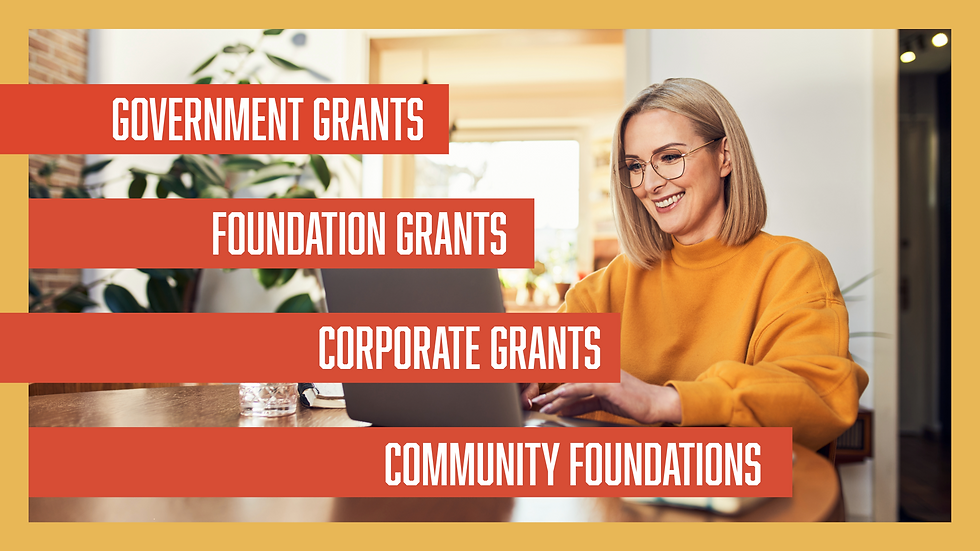
Nonprofit funding in Canada comes from four main sources, and each behaves differently:
Government grants — federal, provincial, and municipal programs, usually tied to specific priorities (housing, youth, health, arts, environment) and renewed annually or by fiscal cycle.
Foundation grants — private and family foundations with their own focus areas and application windows, ranging from a few thousand dollars to six figures.
Corporate grants — company-run community investment or CSR programs, often regional and tied to where the company operates.
Community foundations — local funders (city or regional) that pool donor money and grant it back into their own community.
Most nonprofits end up building a funding mix across two or three of these, rather than relying on one. If your organization has only ever applied to one type, that's usually the first gap worth closing.
Use a database — don't search blind
Manually Googling "grants for [your cause]" every few weeks isn't a strategy, it's a part-time job. Searchable databases exist for exactly this reason — platforms like Grant Connect (Imagine Canada) track hundreds of active Canadian funders in one place, filterable by cause, region, and funder type, so you're not starting from zero every time you look.
That said, a database only gets you a list. The real work — figuring out which of those funders you can actually win, and building the relationship and application that gets you there — is a different skill entirely, and it's where most nonprofits start looking for support.
Filter by fit before you filter by amount
The biggest time-waster in grant-seeking is chasing large grants your organization doesn't actually match. Before you open an application, check:
Eligibility — registered charity vs. incorporated nonprofit vs. unincorporated group. Many funders only accept one.
Geography — national programs are more competitive; municipal and regional funders often have far better odds for local work.
Alignment — does the funder's stated priority area actually match your project, or are you stretching to fit?
Timing — some funders review on a rolling basis; others have one deadline a year. Missing a fixed deadline means waiting twelve months.
A shortlist of five well-matched grants will consistently outperform a list of twenty long shots.
Don't skip the smaller, local funders
National programs get the search traffic, but community foundations and regional funders are often less competitive simply because fewer organizations think to look for them. If your nonprofit has a defined local footprint, a city or regional community foundation is frequently the fastest realistic win — and a good first grant to build a track record with before applying to larger national funders.
Keep a grant calendar
Once you have a shortlist, the biggest failure point isn't the writing — it's missing the deadline. A simple spreadsheet tracking funder name, amount, deadline, and status turns grant-seeking from reactive to planned, and makes it obvious months in advance when your team needs to start drafting.
An example of a currently open opportunity
The Petro-Canada CareMakers Foundation National Grants Program is currently accepting applications (deadline August 14, 2026), offering up to $300,000 to registered Canadian charities working on projects that support family caregivers. It's a useful example of what a well-matched national grant looks like on paper — clear eligibility (registered charity), a defined focus area, and a single annual deadline. If caregiver support connects to your mission, it's worth a look; if not, it's a good model for the kind of program to search for in your own cause area using the databases above.
When it's time to bring in help
Once a funder is on your shortlist, the real time investment starts: writing and positioning the application itself. If your team has a shortlist but not the bandwidth to turn it into strong applications, that's exactly where a grant writer earns their keep.
FAQ
Where can Canadian nonprofits find grants?
Through official government sources like Canada.ca's Grants and Contributions Finder, paid databases like Grant Connect, and free directories like GrantWatch and helloDarwin — plus direct research into foundations and community funders in your region.
Are grants for nonprofits free money?
Yes — unlike loans, grants don't need to be repaid. Most require a defined project, a budget, and reporting on how funds were used, but the money itself is non-repayable.
How many grants should a nonprofit apply for at once?
There's no fixed number, but a shortlist of well-matched funders (usually 3–6 at a time) tends to produce better results than applying broadly to every program you can find.
Comments